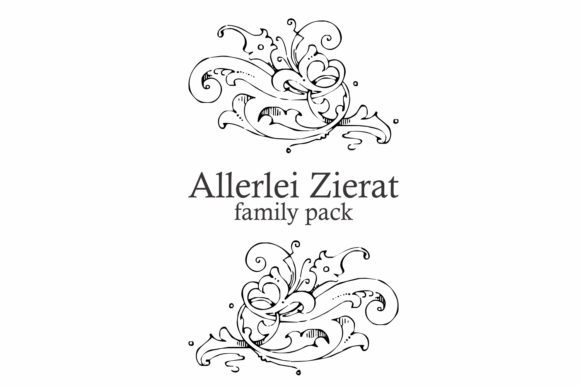
Allerlei Zierat: A Treasure Trove of Vintage Ornaments
There’s something magnetic about a design asset with real history. Not a digital recreation that feels sterile, but a piece of the past, carefully preserved and reinterpreted for today’s creators. That’s the story behind the Allerlei Zierat family. It’s not just a font; it’s a direct line to the ornate, eclectic, and wildly creative world of early 20th-century German printing, born from the legendary specimen book of J.G. Schelter & Giesecke.
A Design Library from a Golden Age
Forget a single typeface. The Allerlei Zierat collection is an entire ecosystem of visual decoration. Intellecta Design’s research and free interpretation brings to life five distinct ornament sets and a set of decorative capitals, all sourced from the 1902 Schelter & Giesecke volume. This book was the encyclopedic catalog for a Leipzig foundry that had just won grand prize at the 1900 Paris Exposition Universelle—a testament to its quality and innovation.
What makes this collection visually appealing is its sheer, unapologetic variety. This is not a minimalist, Swiss-style toolkit. It’s a cabinet of curiosities for your designs. You’ll find:
- Traditional & Classical: Elegant scrolls, flourishes, and figures that evoke certificates and formal documents.
- Jugendstil (Art Nouveau): The iconic, sinuous lines and organic forms of the era, perfect for that touch of vintage elegance.
- Eclectic Motifs: From bicyclists and trains to occupational symbols, animals, and humorous vignettes.
- Heraldry & Religion: Shields, crests, and sacred art for niche projects requiring gravitas.
- Functional Borders & Frames: The building blocks for letterheads, menus, and invitations.
Most elements are presented in striking black-and-white, with some in color, offering a versatile palette that can be adapted to any project’s color scheme.
Practical Magic for Modern Projects
So, how do you use a library of vintage ornaments today? The applications are more relevant than you might think. This isn’t about creating a museum piece; it’s about injecting personality and depth into contemporary work.
For Branding & Logo Design: A single, well-chosen ornament from the Allerlei Zierat set can become the cornerstone of a brand identity. Use a decorative capital for a monogram, or a intricate border to frame a logo. It immediately communicates craftsmanship, history, and attention to detail—ideal for artisanal brands, boutique hotels, craft breweries, or any business wanting to stand out from generic, digital-first aesthetics.
In Packaging & Editorial Layouts: Imagine a coffee bag label with a vintage steam engine motif, or a cookbook chapter opener adorned with a classic floral vignette. These ornaments add storytelling layers to packaging and print materials. For publishers and bloggers, they serve as perfect chapter headings, section dividers, or pull-quote decorations, breaking up text and guiding the reader’s eye.
Across Digital & Social Media: Yes, vintage works in digital spaces. Use a ornate frame for an Instagram story highlight cover, or a set of themed icons (like the occupational symbols) for a infographic about a historical topic. On websites and blogs, they can be used as subtle background textures, favicon elements, or decorative borders for email newsletters, adding a layer of sophistication that stock graphics often lack.
Making It Work: A Designer’s Practical Guide
Working with a family this rich requires a bit of strategy. Here’s how to harness its power effectively.
Choose Your Style with Intent: Don’t just pick what looks cool. Match the ornament’s personality to your project’s goal. A Jugendstil flourish suits a wedding invitation. A heraldic shield works for a law firm’s letterhead. A whimsical cyclist illustration could be perfect for a local bike shop’s social media. The variety is your strength—curate, don’t overwhelm.
Pairing is Everything: The Allerlei Zierat ornaments are display pieces, not body text. Pair them thoughtfully. A strong, modern sans-serif font for headlines can create a striking contrast. A clean, readable serif font for body copy will let the ornate details shine without causing visual clutter. The goal is balance: let the ornaments accentuate, not compete.
Test for Readability and Impact: Scale matters. A detailed border that looks magnificent as a full-page frame might become an illegible smudge when reduced to a 50-pixel icon. Always test your chosen ornaments at the actual size they’ll be used, especially for digital applications where screens vary.
Leverage the Full Family: Explore all five ornament sets and the decorative capitals. You might find that one set’s motifs complement another’s borders. Using elements from the same historical source ensures visual consistency, even if the individual motifs are diverse. This built-in cohesion is a major advantage for building a cohesive brand asset library.
Understand the License: As a premium font family derived from a rare historical work, commercial licensing is key. Ensure the license covers your intended use—whether for client projects, merchandise, or digital products. This protects your work and respects the immense effort of the research and interpretation that made this resource accessible.
The Allerlei Zierat family is more than a collection of glyphs; it’s a toolkit for adding narrative, heritage, and undeniable character. In a landscape saturated with clean, predictable design, it offers a way to connect with a richer visual tradition. Whether you’re designing a logo, crafting a brand story, or laying out a magazine, these ornaments provide the kind of authentic detail that resonates and endures.